Hexagram 20 Unchanging
Or: How Sonic the Hedgehog Stabbing That Celebrity Can Help You Remember The Solution To Life’s Problems
Imagine you're trying to convey your expertise in a subject, or showcase your winning intuition with a skill you claim to have. But you do it by pulling your phone out, and telling your waiting audience that you just have to check something first.
It's not very convincing. And in a world where we're offloading our skills to AI prompts, many of us our homogenizing ourselves, becoming replaceable instruments using interchangeable instruments.
But, there's one avenue out of this path to a potential nowhere, something that's been known for thousands of years: our memory. More specifically: mnemonics, and memory palaces.
How Memory Palaces Changed My Life
Perhaps there's those of us that can claim photographic memory, like the Los Angeles Rams coach Sean McVay supposedly has. For me, however, I digested book after book, and even practiced copywriting professionally, only to need to reference my resource materials instead of embodying the practice.
But it wasn't just copywriting. I got to be great at taking notes. But the notes became both a crutch, and a burden, for whatever subject I was studying. Flash cards helped me recall some things, but it didn't solve the problem for good. And it added hours to my week that I didn't always feel paid off the time burden.
Then I came back to a subject I avoided dedicating myself to: Memory Palaces.
I was always skeptical about how they could help me. It seemed like a parlor trick that wasn't worth the time investment. I didn't want to list out the state capitols at will, or rattle off the names of all of the presidents that didn't make it to dollar bills.
But that was a misconception. I've since created memory palaces that store tools (especially thinking tools) that I can put to use in the course of my day.
Whether it's copywriting tools, or mental health ones, I've been able to access the answers I need, when I need them.
It's a bit of an availability bias benefit thing when you create a memory palace with tools you plan to use.
The more available those tools in your memory palace are, the more likely you are to use them, the more you use them, the more consistent you'll act with them, the more consistent you are, the more it'll become your natural behavior, and repetition is reality.
In sight, in mind: If it's essentially in your working memory, you'll embody it more than you might by simply referencing your source material constantly. The answers will actually be on the tip of your tongue, constantly.
So, what we'll discuss here is how to create a memory palace for practical things that can help you in your daily life, even if you've only been in one room your entire life. And how I've done all of that myself, starting now.
A Note on Mnemonics
Your memory isn't a drawer as much as it's the Universe, if it's to be believed that the universe is constantly expanding. You can keep filling it up.
Remembering your grocery list isn't bound to push out your credit card pin number.
The problem is that we don't encode information properly, which leads us to believe that our memory is depedent on chance, and how much plaque we're accumulating in our brain.
What's easier to remember? A bare Trix rabbit in a steel garbage can getting shot in the head by a distant sniper, or repeating a word, phrase, or idea 100 times, or reading a sentence over and over?
Mnemonics, the key to making a memory palace valuable is about letting our imagination create images that would make people critcize us or see us as aspiring psych-med-success-story-commercial-actors, in order to properly remember what we need to remember.
A Note on Memory Palaces
I resisted using memory palaces for years. I suppose I lacked faith in how effective they were, despite them being talked up by competitive memory athletes, and whoever else that espoused this location-based way to store things in your head. My mistake.
Whether it's homes you've lived in, offices you've worked in, or a Chipotle you've bought many a bowl from, there's certain locations in your mind that you know like the flaws in your face.
And that spatial memory can be hacked to put information on top of it.
By seeing Jay-Z driving a convertible through your dining room window, with a whale in the passenger seat, you can remember a concept like the persuasion technique "thinking past the sale."
An advantage of memory palaces over regular mnemonic linking is that you can think of any location on your route through a memory palace, and instantly recall what concept was nested in a bookshelf, or a sink. A regular mnenonic linking, unfortunately, doesn't allow the amount of hopping possible with a memory palace (if you're not an aberration). You typically have to cycle through the images in order.
By knowing a space well, you can go forwards, backwards, and hop into a bunch of information from any point you want.
And it's not that difficult to create one, which we'll get into next.
How To Create Your Own Memory Palace
1) Understand What You're Committing To Memory
A key point here: Understand the information you're planning on memorizing before you encode into mnemonics: If you don't understand what the concept of anchoring is, it won't do you much good to turn it into a memorable mnemonic image.
2) Compress And Organize The Information You're Encoding In Your Memory Palace
This is important, and I don't really see it talked about, but you want to be strategic with both the locations you choose, and what you're trying to store in that location.
This means that you should first:
If you have notes on a subject, you're going to want to dissect each potential memory palace placement into a bite-sized unit consisting of one idea.
For example, in creating my memory palace for copywriting there's some 'if this, then that' steps that are connected but can't be turned into a single image that would help me recall the whole:
If a prospect you're writing copy to is aware of what you're selling and doesn't want it, then it's recommended to paint a dream outcome and then offer a deal.
For that particular bit of information, the aware and don't want was represented in my memory palace as a Buddhist monk being hit with Chief Keef's meme "Nah" hand, and going into the building's mail slot. Then, painting a dream outcome and offering a deal was represented with Leonardo DiCaprio ('Inception', you know?) painting an image of two shaking hands above Chief Keef's head at the office door.
That might seem tedious to you, but unless your memory works tremendously different from mine, it's necessary just to get that bit of information encoded in a way that I can recall it easily.
So, in a note or notebook page, compress your information into numbered, properly ordered, one idea bits, and then you'll be able to put that piece of information into an image tied to your numbered memory palace location route.
The benefit of numbering all of your memory palace locations and numbering all of the information you're trying to store in your head, is that you can see how much you're trying to store, and how much space you have. By knowing this, you can figure out if you'll need a second memory palace location.
Reminder, though: Don't just go trying to store information to be a completist. Ideally, keep only what you're going to use if you want to use your memory palace for practical reasons.
3) List Out All of Your Potential Memory Palaces
This is a do it once and you don't have to do it again kind of thing.
Make a list of every location you can recall with ease:
- The house you grew up in
- Homes of relatives
- Places you've worked
- Grocery stores
- Movie theaters
- Hospitals
- Dentist offices
- University campuses
- Malls
- Neighborhoods
- Airports
It can go on, and on. It's whatever you know spatially.
But having that list handy will help you when you're trying to find a memory palace to use in the future.
4) Choose And Use One of Those Memory Palaces
Take some time to consider the route you're going to take through this location.
What feels most natural (you want to work with the natural currents of your mind instead of rowing against them).
A potentially bad route may be zigging and zagging back and forth. A better one may be encircling a room, because it's a logical path, and you don't have to remember what amounts to be wide receiver routes through a space, as if you're trying to shake off a tracking missile.
Once you have the route, get a piece of paper and start writing down each location:
- 1) Porch
- 2) Welcome Mat
- 3) Front Door, etc.
Choose distinct locations to write down. Things that you already remember and don't have to strain to imagine. As you gain more experience in creating memory palaces, you'll learn just how bunched or spaced apart your locations need to be.
For example: It's personally hard for me to distinguish between multiple clothing racks in one of my spaces, even though I know the location very well. There's no distinct element to each rack. It's clothes hanging. And despite how many times I've been through this space, I'd have to stop and really think to remember just how many racks of clothing there are.
Don't get greedy and try to fit as much information and stops into a space, only to shoot yourself in your big left toe when you realize that it gets jumbled in your mind upon review.
For me, I've learned I can have a couple locations bunched together, but when it gets to three or more, it's a little too mixed up. So, I try to have no more than two indistinct slots to put information in before I give myself some space before the next one.
To help you better understand what I'm saying: If you have a kitchen shelf with three levels to it, I'd probably just try to make the shelf one location, instead of trying to remember something distinct from each level to attach to something I'm trying to remember.
Or if it's a sink with a sponge near it, a hot and cold option, a dish brush, I'm going to just use the sink itself and call it a day when it comes to that area of my memory palace.
Perhaps you can manage to make all of those little things distinct, but from my experience, it's just not worth it to try based on how my mind works.
Once you've listed out your route, we can go to the next stage of the process.
5) Creating The Memory Palace And Mnemonic Images
Quick note: Don't try to be a perfectionist. Definitely try to save the largest and best visualized memory palaces for the most important information you're trying to remember, but remember that new memory palaces can always be created, whether that's by going to new places physically, or by what we'll get into a little later with creating new memory palace locations.
But, once you have your note of listed out compressed information, and your memory palace, with the route listed out and numbered, you can begin to combine the two.
What you should know is that you have your own, Personal Mnemonic Language.
There's certain subjects, topics, characters, and personalities that your mind naturally uses as the raw materials for mnemonic imagery.
For me, it's rappers, old video game characters, movie characters, and athletes.
Lean into this imagery of yours, whether it's Disney characters or the Antwerp Six, instead of overthinking it.
The Process
A) Association
What other thing does this look like, sound like, feel like, relate to, remind you of, associate with.
First thought might not be best thought, but first image might be best image. You want your recall to be natural, so let your natural associations form the bond between your memory and the information you're hoping to store in it.
My recommendation is to come up with as many associations as possible between your location and the information, and then write it down.
You're hooking more and more associations on to your information, like you would a Christmas tree. The reason why? If you forget one association, a secondary one might stick and be enough for you to recall what you need when you need it. Build more associations than you think you need, because it's less likely to deteriorate in your memory.
Ex: For me, the Spanish word Sala is remembered by thinking of the football coach Robert Saleh fighting a wrestler I grew up watching: Scott Hall, in a big room.
Ex: Scale Economies being one of the 7 Powers in strategy is remembered by me seeing a bunch of lizard people typing away on computers in an office.
If you were to go ahead and attempt to remember those two things, your mind would likely generate completely different imagery. Use the visual language you already possess.
B) Extremes
It's much easier to remember an explosion than a day on the couch.
Blood, gore, disgust, extremes, utilize it all to remember things better. The more outrageous, or offensive the imagery, the better.
These images can stay private, in your head, or described on a piece of paper. So don't worry about others getting mad at you for what your mind naturally cooked up. The goal is to remember.
C) Link Your Imagery
If there's a duck in your last location, make the next image include that duck in some form or fashion.
You're leaving breadcrumbs for yourself throughout your memory palace, and it functions sort of like a relay race, passing the baton from your front door to your living room window.
This connection between one location and another is key.
D) Write Down Your Imagery
Here's how I format my memory palace notes:
1) (Keyword/Name of Concept I'm Committing To Memory)
(The scene described and written out in full, listing all of the associations, and extremes while mentioning what location you're using and/or how the imagery is connecting to that location)
You don't have to write out your imagery exhaustively, but enough that it's going to trigger the recall when you read it, if you ever have to read it.
Alternatively, some people draw a picture of their image. Since I have memory palaces with over 50 locations/pieces of information, I prefer to write it out instead of drawing.
Stick to the rule of: one idea per image. Don't try to store a whole process in your memory palace as one item, unless you already remember that process.
E) Examples of Memory Palace Imagery
Using my memory palace for copywriting:
- Information: If you're first in the market, dramatize your offering
- Image: Pete Alonso (He's a first baseman in Major League Baseball) with one of those stereotypical drama masks beating Cam'ron (a figure from the location before this one in the memory palace) with a bat near the office window.
- Information: If second in the market, copy the winning approach, and one-up it
- Image: Stopwatch with arms and legs (my immediate image for "second") instantaneously cloning Pete Alonso at the next room's door (the "copy" part), making a one-up Super Mario type video game image appear
- Information: They've heard all of the extremes in the market
- Image: The wrestler Cactus Jack (Extreme) beating the stopwatch with a giant ear (The "heard" part) on the head chair at the table in the room
As you can see with the above examples, I'm using the imagery that my mind naturally gravitates to, with the shorthand that I've gained just by living, and I'm connecting what came before to the location that comes after.
I'm also using one character or subject or image per idea. I'm not thinking of every first baseman I know, I'm using someone I watched play for the Mets.
Be strategic, but don't overthink this. Keep your notes, number your locations, number your compressed information, and let your imagination do what it naturally does. You don't have to use athletes, entertainers, or antrhopomorphized objects, it's best to use the images and associations that flow freely when you apply yourself to the task at hand.
6) What To Do When You Run Out of Personal Memory Palaces
There may come a point where you lack locations that you know well enough to use for new memory palaces. But there's an unlikely solution I found: AI. Let's talk about that option.
A) Option 1: Google Gemini/Your Personal Favorite AI Service
My favorite way to make new memory palaces is Google Gemini.
There's a lot of things to dislike about AI, but for memory palaces it's a wonderful tool.
After exhausting my immediate memory palace locations, I thought to myself: What if I tried to use Gemini to create a place, to my specifications, that I could use to store information in. And it worked.
This is an area you can get creative with, but let's go with a variation of my most helpful prompt first:
"Generate a photo of a furnished living room featuring a desktop computer, laptop, TV, a fridge, recliner, bookshelf, drying rack, in an Aspen ski lodge style, that allows me to see as much of the room as possible, while also placing the objects in more of a sequential than cluttered or stuffy manner, keeping the middle area free from objects"
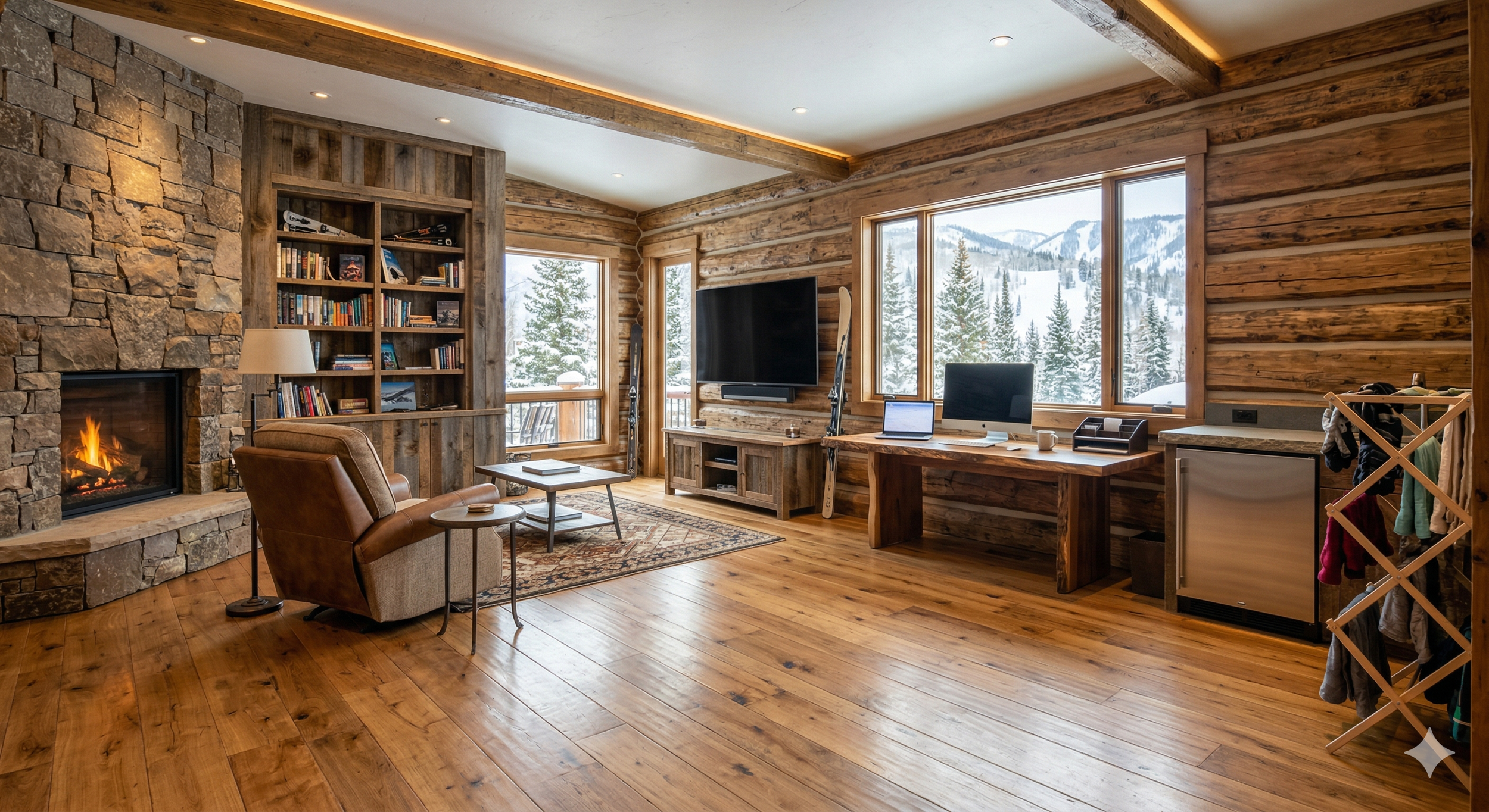
As you can see, I can start the path at the clothing rack on the right, and then go counter-clockwise through it, placing pieces of information at the landmarks.
After some experience, you'll know what memory palaces are easier for you to store things in. Maybe you'll like a lot of objects that some would call cluttered.
For me, I like to have no more than two locations bunched together, and I like for objects/furniture to be arranged in a clear, easy-to-follow way, to avoid unnecessary mental trouble when trying to recall my path.
And if there's not enough locations in an AI-generated image for your liking, you can always change your prompt to be a master bedroom, a bathroom, a driveway, etc. and then connect them the way you naturally do with locations you have actually stepped in.
Additionally, switch up the architecture styles, making a brutalist bedroom. And if you want to connect an AI-generated living room to an AI-generated bedroom, and so on, then ask Gemini to put a cardboard cutout of a clown (or a 'real' one if you'd prefer to make it even scarier) in each room so you can remember: this is my science class memory palace.
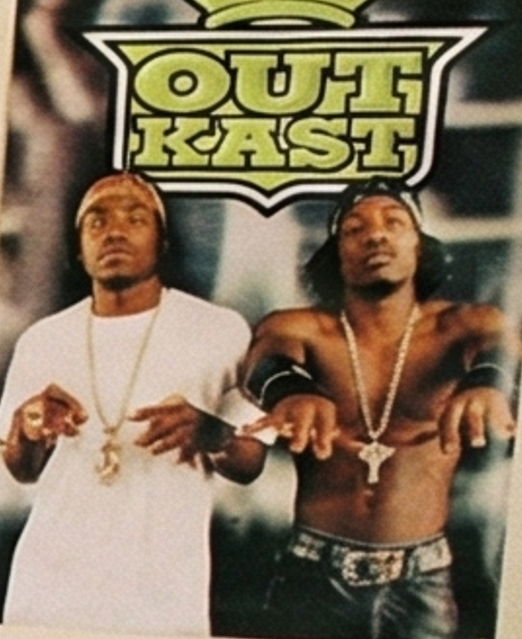
Also a funny thing might happen as you experiment, like uncanny valley Outkast posters that make Big Boi and Andre 3000 look like Sunset Strip impersonators when you zoom in:
--
So, see what works. Try changing that prompt by altering the decade the room is in, the architectural style, the city, state, country, geography, furniture, decoration, type of room, or weird distinctor like a pink giraffe.
Once you have a room, or rooms, you write out each numbered location according to the route you'll take through it, and execute as same as ever.
I find that I learn these AI generated rooms that I've never stepped in when I write down each location in the image that I intend to use to store information. The act of writing down 1) Balcony, 2) Couch, etc. maps it out in my head, just by making myself expend a little more effort in deciding on a route I'll take through that image.
And there's times where my brain, in creating mnemonics, and recalling the images, makes a 3D map of the room, despite it being a 2D image. But once again, we're different people, so you can see what works for you.
B) Option 2: Zillow
Now, this will take more work, and more time, but it still can be done: Using Zillow, and in particular, Zillow 3D tour views, to create a memory palace location route.
Take screenshots of your route and each area of the home and keep it in a folder, so that if it goes off the market, you can still review your memory palace when your memory falters.
C) Other Options
If you play 'The Sims', create a home in the game and use that.
Alternatively, there's Google Maps and Street View.
There's likely other options you can come up with if you get creative enough, but use what works and get on with it, because the goal is ultimately to remember something, not do location scouting for a Hollywood movie.
7) Additional Tips
A) Repeating Concepts/Characters
In several memory palaces, there's repeat characters, and that's by design.
For repetitive concepts, words, or ideas, turn it into a repeatable character or image.
For a word like "authority," which would be applicable to something like persuasion techniques, and copywriting, what pops into your head when you hear that word? For me, it's Stephen King. So in both memory palaces, I'd have Stephen King *doing* something when I come to a piece of information about authority that I'm trying to remember.
But: maybe don't have the same character pop up multiple times in the same memory palace. This might work out fine for you, but if I have Stephen King Suge-Knight-like holding someone out of my home's second story window, it might blur things together if he reappears later in the bathtub.
When you're compressing information that you're going to put in a memory palace, though, just remember that certain subjects will be easier if you create a symbol like that to stand in for the recurring concept.
B) Seriously, Keep Notes on Your Memory Palaces
I have a binder to store my memory palaces. You may be creating memory palaces to avoid ever needing a binder, and really, same, but keeping notes like this is going to be your best choice to avoid the natural memory recession that we all experience.
If you go to review your memory palace and you realize there are some gaps in the imagery, having a notebook or binder with that information will help you save it from slipping away for good.
And if you plan on using memory palaces for the rest of your life, it's a small, but valuable investment.
C) Use Flash Cards To Trigger Reviews
I have dozens of memory palaces at this point and I use a flash card app called "Anki" to trigger my reviews.
It's a spaced repetition system, so it'll remind you to review your memory palace at key points, to ensure long-term recall.
It's not complicated:
- Create a deck in Anki for Memory Palaces
- For each memory palace put the location (That Chipotle I go to downtown) and the answer will be the subject stored in that memory palace (Mental health tools).
What matters is not really what's on the front or back of the flash card, because you're not making a card for every location and piece of information. You just want to be reminded of the location you used and the subject of the memory palace, so you can close that app and run through your mental review/recall.
And then if you get some of it wrong, you'll click the "10 mins Again" button, review it until you get it right, and then choose whether that was "hard" or "easy" and it'll decide how soon you'll need to review that one again.
Of course, you can set calendar reminders to review these things, but I find it easier to just let the program schedule a review for me in a couple weeks (or however long it decides).
If you don't actively recall your memory palace, it's bound to degrade. Just keep that in mind.
D) Last Reminder
You *will* forget things.
It's not unusual to try to recall all of your locations a couple weeks after you made it, only to find that you remember just 79 percent of it. Or 85 percent. That's what review is for.
Don't be discouraged, just dedicate some time to review.
Ultimately, by building a memory palace you're empowering yourself in ways that "prompt engineering" will never be able to.
You're using your memory, and if all of the power in the world goes out one day, you'll have your toolkit of mental health solutions, which will surely keep you from wasting away in the wilderness.